
In past post I’ve outlined the framework for how I write my programs and how I work out. My version of the conjugate method works for me and would likely work for a lot of you (there is no perfect program that works for everyone) but I don’t run it every single week of the entire year. Instead I use “changing” blocks or even just weeks at the end of blocks. Today I’m going to walk you through why and how.
What is a changing block?
This part of the equation is easy. In short you’re just changing the type of stimulus that you’ve been working with. This is a little bit harder with conjugate because by the definition of a conjugate program, you’re working multiple skill sets at once, but you’re still likely not working everything.
When it comes time to run a changing week or block, you’re simply going to look at what you have been doing, and do something different. That’s it. By this I don’t mean move your floor press to close grip floor press, I mean changing from doing low volume high intensity work to focus on max strength to high volume for work capacity, or bodybuilding. You can even switch to some strongman stuff.
Why do a changing block?
I have a few reasons for doing these, I’ll walk through all of them.
Reason 1 – Your body adapts:
If you do the same thing day and day out your body is just going to get efficient at doing whatever you’re doing, eventually you’ll reach max efficiency and won’t improve. You’re efficiency will also make it harder to get stronger. By changing up what you’re doing, you make it harder for your body to adapt and force yourself back into situations that stress your body enough to stimulate growth or strength gains.
Reason 2 – You won’t include all needed skills in a program, yet still need to work them:
Regardless what program you are running, you won’t be able to hit everything you need to hit, due to time and energy constraints something will be left out, there is no way around it. You can use a few changing weeks to bring up whatever it is that is lagging. This can be cardio, it can be some of your ancillary stability muscles, it can really be anything. You just need to identify it while in your program and hit it on changing week.
Reason 3 – Training gets redundant and changing keeps it fresh and fun:
I know what some of you are thinking “training is a grind bro, it shouldn’t be fun”. No, that’s wrong. Go talk to all the high level lifters, they love working out, it’s their passion. No one is paying you to go squat weekly, you need some sort of internal motivation to go do it. Changing it up, trying new things and just having a few lower stress weeks in the gym is a great way to keep the passion not only alive but consistent. You’ll have better workouts if you do so.
How do I run changing blocks?
It depends… Don’t you just love vague answers.
As I said above, I like to take a long hard look at what my previous block was and where I think I’m lagging to make this decision, but I still 3 go to types of changing that I like to do. Lets walk through them.
Changing Example 1 – Strongman training:
I’ve done strongman competitions in the past but haven’t in a few years, my training no longer resembles strongman training, but I do still have the implements. After a long block of squatting, benching and deadlifting I’ve found it beneficial to take a couple weeks to carry some sandbags, press a log and lift some stones over my yoke. This keeps me mentally fresh and puts my body into different movement patterns than I’ve been working, which helps my joints long term.
On top of this, strongman work will very, very quickly point out any weaknesses you have and will give you a lot of data that you need to move into your next block. If you have any weakness in your core, upper back or glutes it will be exposed. You may be able to hide this with your powerlifting lifts, not with strongman. If you have access to any strongman implements, give it a try, I know John Haack (the current GOAT of powerlifting) does strongman training in the offseason.
Changing Example 2 – Bodybuilding
I use this often, but cards on the table I find it super boring which is probably why I’m not a bodybuilder. Well, that and the diet…
The bodybuilding change works for a few reasons. One is that adding mass and muscle will always help you be stronger, don’t let anyone tell you any different. Second is that the lower weights used will help take some stress off your joints for a couple of weeks and promote long term health. Third is it allows you to take time and build muscles in your weak areas. Rear delts screwing up your bench? Hammer them for a few weeks then go back to heavy benching, its that simple.
Changing Example 3 – High rep (20 or more) compounds:
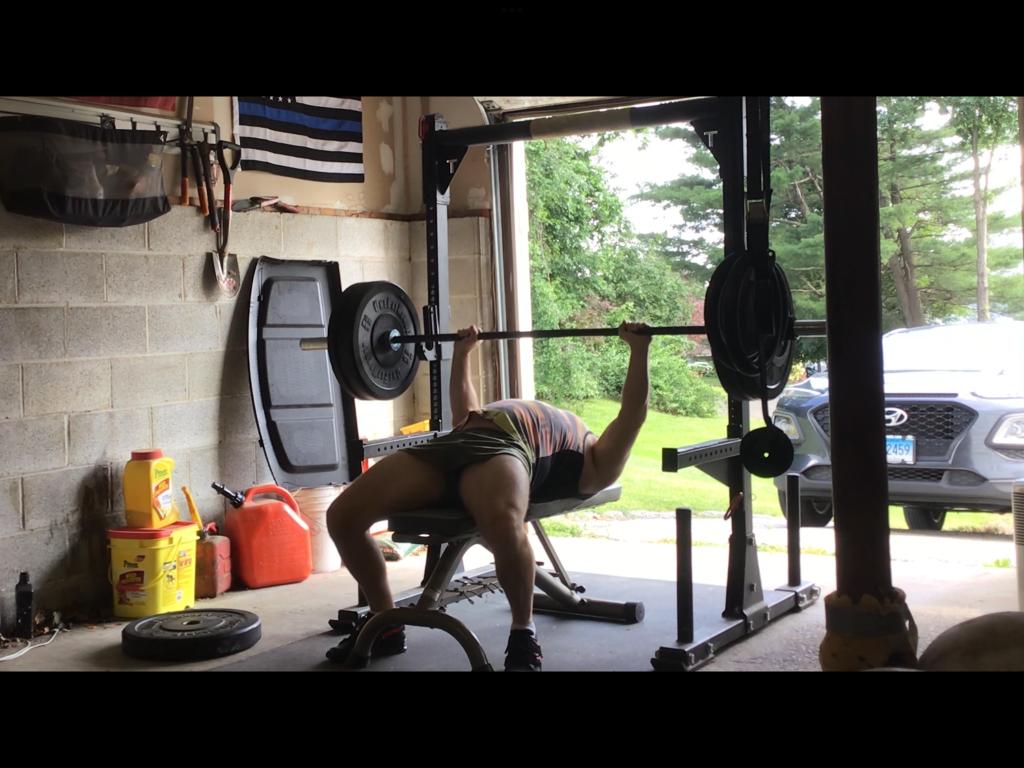
See me in short shorts starting my bench set of 205 for 23, this is about 20lbs over my body weight…
This is what I’m doing right now, it both sucks and is fun. To do this I’m working up to a couple of top over warm doubles and then backing down to a weight I think I can hit for over 20 reps for a long AMRAP set.
Why do I do this and what is the benefit?
My main intention is to expand my work capacity and cardiovascular endurance. This seems simple enough but what is the benefit to this? The more work your body can handle, the more work you can do and the more muscle / strength you can add. There is a reason Louie Simmons talks so much about GPP (General Physical Preparation) and its importance, you need to be able to make it through your program to see its benefit. If you’re an intermediate to advanced lifter, you’re program should be hard enough to where you need to be in shape to run it.
On top of this, a few weeks of 20 rep squats or deadlifts can be a great way to either gain or lose weight if you need to alter your body composition. Just change your diet to fit what you’re doing and you’ll find you either burn a ton more calories than normal or you’ll put on a bunch of muscle because of the toll this puts on your body (see Super Squats for reference). Word of warning, 20 rep squats and deadlifts suck if you’ve never done them, I’d much rather do max effort work…
Conclusion
I’m a big fan of these blocks and run at least a few a year. While others may structure as just “in season” and “off season” I understand that most of you aren’t going to be competitive lifters who even have a season, so a changing week or two every 10-12 weeks is a good strategy for long term sustained success in the gym. Try them and have some fun with them!
 Middle Aged Muscles