
Starting with the same disclaimer from my previous posts in this series. I do not compete as a powerlifter, I have competed as a strongman in the past and MAY do a powerlifting competition in the future. Still, I use my version of Westside template as I enjoy it and I think it is easy to transition back into strongman from it if need be.
I’d be remiss if I didn’t come out and say that DE (Dynamic Effort) Lower is my favorite day of the week. I know that sounds odd as most of the Westside guys would lament it as the tempo is high, the effort is high and it was the one day that if not done right, could really burn you out. In the scheme of things I’m a smaller guy (185lbs) and I don’t like to sit still. The constant motion of dynamic effort day fits well into my mindset and I look at it as an opportunity to improve my conditioning.
Prior to getting into what I do, it may be helpful to explain what Dynamic Effort day is. Rather than digging out the Westside Manual or Supertraing to give you text book definitions, I’m going to put this in my own words:
In essence strength isn’t something you have, its something you generate. You do this with a mix of slow twitch and fast twitch fibers. Your slow twitch fibers are what help you grind through long lifts, or hold isometrics, or stabilize etc… The fast twitch fibers create momentum for you so your slow twitch fibers don’t have to work as hard. If I asked you to roll a heavy boulder that was stationary, it would be hard to get moving, however if it was moving slightly already, it would be significantly easier. Your fast twitch fibers are what you use to create the momentum, aka “get the ball rolling”, on the barbell that enables you to finish the lift.
The reason we do a dynamic effort day is to help build these fibers. Both fiber types are equally as important which is why Westside did a day dedicated to slow twitch fibers and grinding (Max Effort or ME Day) and a day dedicated to fast twitch or Dynamic Effort day. The way we do this is exactly as you think, we use light weight and move the bar as fast as we can while still maintaining our form.
On to how I lay our my DE day, its worth noting you have a lot of choice here. Your dynamic effort movements don’t even have to be squats and deadlifts, things like box jumps, power cleans, clean pulls, sprints and even sled drags can be used. These are great options for people training for sports and younger athletes. I’m an older athlete not training for sport so I use squats, particularly box, and deadlifts. Example day below:

Starting with our two main lifts. While I listed deadlifts first, they don’t need to be done first and typically Westside wouldn’t. Feel free to do squats first or even rotate. For deadlifts you’ll notice on this day I have 6 singles while I’m doing 5×5 for squats. Your volume on squats will always be higher than on deadlifts, the reason for this is two fold: First, squats are a better lift to build overall explosion and second, if using a box, a lot of the same muscles in the posterior chain are used that would be in a deadlift. The most reps I’ll do on a DE day for deadlifts is 10, and this is usually on the first day of a 9 week block, the most reps for squats is usually 25 and I’ll usually be at this number the first week of each 3 week wave (I write blocks as 3, 3 week wave’s).
For squats the 5×5 can easily be changed to 12×2. The question arises on when and why to do each. For me, I used 5×5 when I feel my conditioning needs to come up and I want a little bit of hypertrophy in my workout. When I want to concentrate solely on explosion or work on my technique I do 12×2. I wouldn’t get lost in the details on this, you can use 12×2 but change it to 5×5 the day of if you’re short on time, but in reality if you do this right you should get through 12×2 in the same amount of time you would 5×5. The reason is when you do 12×2 your rest periods should be very short, only 45-60 seconds. On 5×5 you would go to maybe 90 seconds. Deadlifts should also only have a 45-60 second rest period.
For both the squat and deadlifts I have written to use 45% – 55% bar weight plus bands or 65% to 75% if you aren’t using accommodating resistance (bands or chains). Regardless of whether or not you are using accommodating resistance, the top of the lift should always have somewhere from 65% to 80% of your max at the heaviest point. With this in mind, if you were using 45% bar weight, your accommodating resistance should be somewhere between 20-30% of your max, knowing bands specifically are hard to dial in, you need to use this as a range. If you’re a raw lifter I’d encourage you to play around with the band tension that works best for you, you can even wave this.
For example right now I’m running a 9 week wave where my first 3 weeks are 33% band tension, second 3 weeks are 20% band tension and last 3 weeks have no band tension. I increase the bar weight percentage every block so at the top of the lift, I’m still always waving from 65% to 75%.
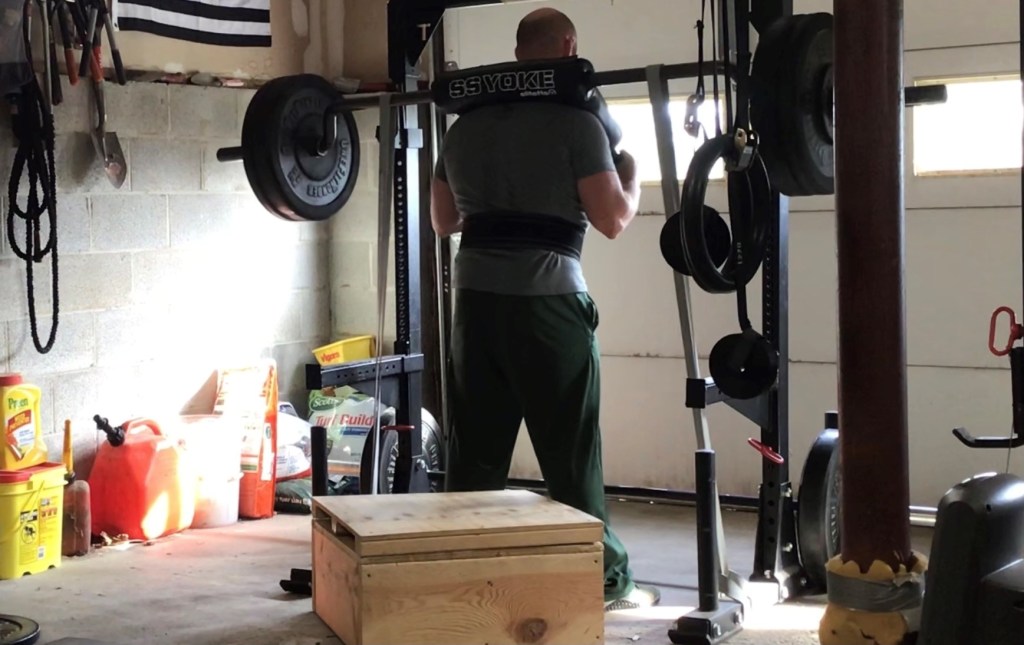
A big question on squats is whether or not these need to be box squats. The short answer is no, you don’t even need to use squats so they certainly don’t need to be box squats. I however, prefer to use a box for at least 2/3rds of my dynamic work. I do this for a few reasons:
- I’ve struggled with squatting high in the past, the box forces you to squat to a certain depth
- On a “free” squat I use the bounce, the box cuts that out and makes me work harder in the bottom position of the lift
- You recover faster from box squats
- If done correctly and you use the cues of using your hamstrings to “pull” you off the box, they work the same muscles as your deadlifts and can build both
A good 9 week wave would be weeks 1-3 to a box with heavy bands less bar weight, weeks 4-6 to a box with slightly lighter bands and more bar weight and finally weeks 7-9 as a free squat with all bar weight.
Deadlifts aren’t as complex, unless you want them to be…
I would look long and hard at where you’re weak in a deadlift and set your block up to help that. If you’re week off the floor I may use the same weight but wave deficit height. An example for a 500lb deadlifter could look like this:
- Week 1: 315lbs, no accommodating resistance from the floor 6×1
- Week 2: 315lbs, no accommodating resistance from a 2″ deficit 6×1
- Week 3: 315lbs, no accommodating resistance from a 4″ deficit 6×1
If you’re weak at lockout, you can do something similar using growing band tension to make the top portion of the lift harder as the wave progresses:
- Week 1: 315lbs, no accommodating resistance 6×1
- Week 2: 315lbs, light bands 6×1
- Week 3: 315lbs, average bands 6×1
In this lays my favorite thing about conjugate and also what will make you the most successful using it.
Any conjugate program can and should be tailored to attack your specific weak points. Build these up, and you’ll be strong
BiteyMax22
Once we’ve moved past the dynamic work we move on to our assistance. Again, you can use whatever rep scheme you want with this, but I like to use these days to work up to a rep max waving from 8-4 reps. If I did a squat movement on ME day, I like to use a deadlift movement on this day, if I did a deadlift movement on ME day, I’ll use a squat movement. For example this week my ME movement was a SSB front squat, correspondingly when my dynamic effort day rolled around I did deficit deadlifts with silver short bands to an 8 rep max. I’ll change exercises the next 2 weeks but when the 3rd week comes around I’ll repeat this to a 6rm, then a 4rm 3 weeks after that. This will finish my block.
The rest of the day is simple, I do abs and some sort of mobility or glute work as accessories. Abs should always be in your program and the mobility/glute work is my choice as this is a weakness for me. Much like I mentioned before, your accessory work should be targeted towards the specific weaknesses that you have. If you have to do 2-3 of these exercises, fine, I frequently do too. If its more than that I’d suggest doing them as an “extra” workout later in the day or the next day.
Finally I do a burn out. I have a few different ways I do this but my favorite is to just set a rep target (say 100) and hit it in as few sets as possible. I typically like to take a larger movement, such as a reverse hyper or GHD, and do this with light weight. My reason for this is it not only builds muscle but also helps build your conditioning and GPP. Much like everything else, I’d use this to attack a weakpoint or to balance out your day. What I mean by balance out your day is simple, if most of your day worked posterior (hamstrings/glutes) use this to attack your anterior (quads/psoas). Conjugate is flexible, don’t feel like you have to do the same thing week in and week out, do what you need instead.
This should help you set up your DE lower day. Again, I encourage you to play with things and find what works for you. Some will do better with bands, some with chains, some with no accommodating resistance. Boxes, no boxes, jumps instead of squats, they can all work, just find what works for you and remember, just because it works now doesn’t mean it will work 6 months from now. Be ready to change and adapt, its actually the part of this that makes it fun…
 Middle Aged Muscles